Sunday, August 9, 2015

Milksnakes on the Plains


Milksnake
Milksnake in Mark's Hand


For most people, the July 4th weekend means fireworks and barbecue.   When you are married to a herpetologist, searching for snakes is part of the festivities.  On a hot summer day, I enjoy milkshakes.  My husband Mark enjoys milksnakes.

Excerpt from Mark's journal for July 5, 2015

The Spring rains nourished the sand dune country of Roggen, Colorado, home to milksnakes, green racers, bullsnakes, six lined racerunners, prairie rattlesnakes, and box turtles. Going into the Fourth, the rains weren’t heavy, but I was determined to find a milksnake, lampropeltis triangulum, subspecies-multistriata. Telling Jeanie about my Roggen sand hill adventure, she was worried that I would be kidnapped by aliens, hit by an Amtrak train, drive off the road, or die of heat stroke. So she accompanied me to Roggen, little more than a granary station two hours north of Denver. She sat in an overheated truck next to the highway while I hiked the sandy terrain of [my son] Isaiah’s youth. 

Note from me:  I was concerned about him herping by himself, but he is slightly exaggerating.  I never mentioned aliens, but Roggen would be a good flat place for them to land.

The habitat was drier than expected, and the Burlington Northern Railroad had ripped the soil on both sides of the tracks for twenty yards. The huge clawed ripper disturbed kangaroo tunnels, box turtle homes, and the sandy trails supporting the two local lizards-the prairie lizard (Sceloporus garmani-a cutie), and the green tropical looking six-lined race runner. 

A bit disheartened, I hiked to my area of snakey success. By my figuring, I’ve caught and photographed three generations of milksnakes by a particular blue and white car door. My first was a juvenile milksnake, red-white-and orange banded, which fit in the middle of my palm, and was my first milksnake ever. Years later, I caught and photographed another one, and today, I photographed the great grandson of them all. Peering through a dilapidated plywood hole, I spotted a banded beauty moving below me. With a rehearsed routine, I flipped the board and caught the multistriata milksnake before it had a chance to escape down his hidey hole.
             
My trophy milksnake was photographed in hand, in my straw hat, in a green butterfly net, and against his native sandy soil. The snake often tried to escape, but a little tap near his black snout, and I was able to force him into a photogenic coil. Milksnakes make great photographic subjects, and I was glad to find another member of the family tree. He was returned safely to his hidey hole beneath the plywood. 

Milksnake in Mark's Hat
We spotted a large jackrabbit bounding through the yucca and sage. If you’re accustomed to viewing yard bunnies, a jack rabbit looks like a huge animal. With ears shooting upward, the jack rabbit bounded in enormous strides over the sandy terrain until it was out of sight. This was a particular treat since jack rabbits haven’t been spotted in this part of Colorado. At least, not to my knowledge. We’ve never seen them in Roggen before. 

Note from me:  I  wish that we had gotten a photo of the jackrabbit.  It was almost the size of a jackalope.
Heeding Jeanie’s advice, we relocated to Barr Lake, home to mating pairs of Bald Eagle. Walking the boardwalk, we saw yellow warblers, white American pelicans, mallard ducks, and a juvenile Northern Harrier. Water saturated cottonwoods provide a heronry to the Great Blue Heron, and other nesting birds. I’ve seen a few Blue Heron along the South Platte, but a large male sported a wingspan exceeding six feet.  It’s been a while for me, but I spotted a male Bullock’s Oriole in breeding colors. Somewhat reminiscent of the Baltimore Oriole, they are a striking orange color. 

Barr Lake
Don’t worry, Jeanie enjoyed the boardwalk, and was later rewarded for her efforts. We dined at Chili’s to enjoy some air conditioning and food. She was glad to return to civilization, knowing that aliens had not kidnapped me, the Amtrak train missed me, and I managed not to drive into a lonesome ditch.

Note from me:  It was an adventure, and it made Mark very happy.


Sunday, March 15, 2015

"The Felinius Healer"

My husband Mark has written a novel and published it on Kindle Direct.

Surprisingly, it is not about reptiles and amphibians. It is a fantasy action romance. If you like fast-paced novels with interesting characters, this novel is for you.

This is the Amazon page for ordering it:

http://www.amazon.com/Felinius-Healer-Novel-ebook/dp/B00TNO3IJE/ref=sr_1_1?s=books&ie=UTF8&qid=1425867577&sr=1-1&keywords=felinius+healer


Herping in Houston by Happenstance

I recently flew to Houston to visited my cousin Ida and attend a concert.  My herping husband Mark has been talking about Houston since Ida sent a photo of a Schott's whipsnake skin that was under her porch.  Ida wanted to know if it was venomous, but it was not.

Mark decided not to go since it sounded like we would spend a lot of time consignment shopping, eating, and talking non-stop.  (He was partially correct.)  I told him that I would look for reptiles and amphibians, not expecting to see any.

On February 22, as Ida and I strolled through Bayou Bend, I spied some lizards (later identified as anoles). 


Ida took pictures of them with her camera and sent them to Mark.  

Mark responded, "...Those are brown anoles, common to the Texas, Florida, and Mississippi. When they sit on fence posts,they extend a colorful dewlap or chin fold. Winter colors aren't so interesting. For camouflage, they can turn a brownish green while situated in dense green foliage. Hardy little souls , there small bodies allow them to soak up relatively little heat, but they're goal tending the escape hole...One brown anole lost his tail, but it will grow back, a little shorter this time. Did you watch the chameleon style eye movements? The little guys rotate their whole eye socket, never turning their heads."
 
Ida also sent a photo of me (which I cannot find).   

Mark responded, "This one is a homo sapien. She likes to take strolls in sunshine. Flies great distances to attend second hand consignment shops with her cousin. Often times found wearing teal garments. Likes to smile for photographs. Rarely aggressive."


P.S. If you are in Houston to herp on purpose or by happenstance, consider going to the River Oaks Chamber Orchestra, founded by my longtime friend Alecia (http://rocohouston.org/).

Sunday, May 25, 2014

The Ohio Salamander Migration

The following post was written by my herping husband Mark.

I traveled to the hinterlands of Ohio in hopes of witnessing the Great Salamander Migration. During the months of March and April, the Yellow spotted salamander (Amystoma maculatum) emerges from the frozen leafy forest floor to migrate to vernal ponds. The Yellow spotted salamander is not alone in this annual ritual, but is accompanied by other companionable amphibians such as the Small-mouthed salamander (Ambystoma texanum), the Jefferson salamander (Ambystoma jeffersonianum), the Eastern Red Eft, the Spring Peeper (Hyla crucifer), and the Western Chorus Frog (Pseudacris triseriata). 


Small-mouthed Salamander
This Small-mouthed salamander is held by a teenage girl who was quite enthusiastic about wading through knee deep freezing water in search of nature's little gems. 

Jeanie's Comment:  I was happy not to be in knee deep freezing water.


Spring Peeper

I had trouble with the camera focus for this shot, but the telltale signs of the Hyla crucifer can be determined by the cross on the frog's back. The Spring Peeper ranges in size from a dime to a quarter.


Western Chorus Frog

The triangular snout of the Western Chorus Frog brings back fond memories. Children waded through the shallows of our dark vernal pond, passing this Chorus frog back and forth by flashlight. 

With high hopes,  I set out toward the Stratford Preserve expecting to witness my first Yellow spotted salamander migration. By report, the clay driveway has been littered with hundreds and hundreds of these tiny black salamanders making their way to the mating ponds. 

I flipped fallen logs and did manage to find a male yellow spotted salamander. I staged my land dwelling salamander against a yellow leafed backdrop and another shot against a moss covered log. 


Yellow Spotted Salamander
Yellow Spotted Salamander on Mossy Bed


For those of you who live in the South, you may recognize this vernal pool as having Cypress knees. This photo was taken at Dawes Arboretum in Ohio. However, the yellow salamanders have adapted to the northern Cypress pools and mate here every year. 

Cypress Knees in Eastern Ohio 
In addition to my nocturnal forays, I did visit with my parents and we toured a Conservatory with a Butterfly Pavilion. 

Tropical Butterfly

Next year, I hope to witness a full migration, and add photos of Red Efts. 

Sunday, March 2, 2014

Ode to Turtles in the Tub

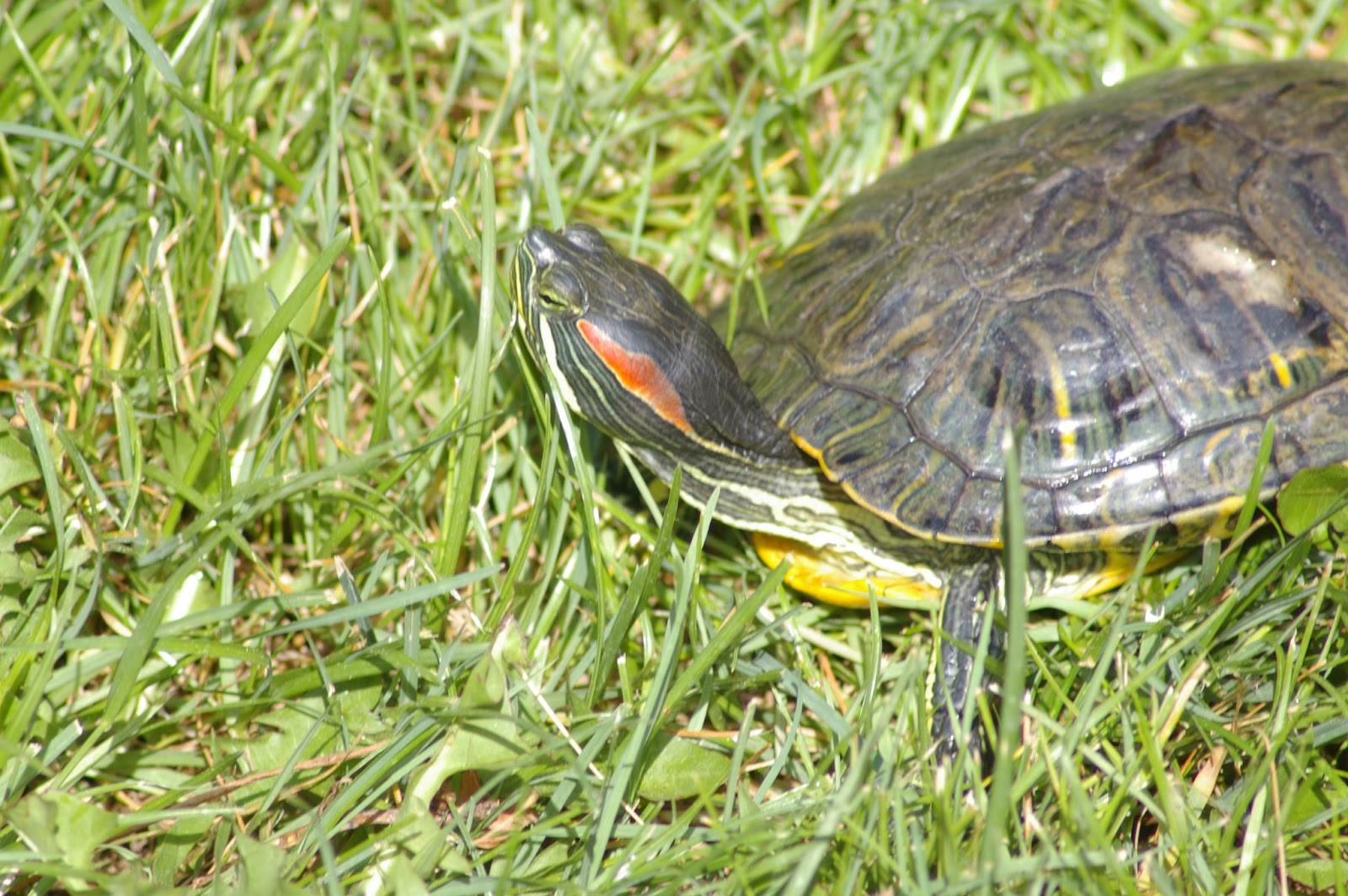
Our red-eared slider turtles, Kermit and Miss Piggy, inspired me to write this haiku:

Turtles in the tub
Bucket lids for lily pads
The cat thinks, "How odd!"

Explanation:  My husband Mark was concerned that Kermit and Miss Piggy were not getting enough exercise during the winter.  Their indoor tanks did not allow enough room for them to do full swimming laps.  He started putting them in the bathtub for weekly swims.  Home Depot lids were stand-ins for lily pads.

In this picture, shy Kermit is on the left. He is partially hiding under his orange Home Depot lid lily pad.   The larger and bolder Miss Piggy is on the right.   The white on her shell is from her turtle shell conditioner.  It's like Oil of Olay for turtles. 


Here is a picture of Kermit hiding under his orange plastic lily pad.


I don't have a picture of our cat Sasha looking at the turtles, but their splashing attracts her attention.  After Mark spends quality time with the turtles, she wants her share of affection.  This is her "pet me" look.


The turtles will soon return to their outdoor tank, but I will miss tub time for the turtles.  

Bonus for me:  Mark cleans the tub thoroughly after their swim.


Sunday, July 7, 2013

Kermit and Miss Piggy


We have decided to name our turtles Kermit and Miss Piggy.   The female has a healthy appetite and rapidly learned to make eye contact to incite her captors to feed her. Since she earned the nickname Miss Piggy, it was only natural the smaller male should be named Kermit.

Kermit
 

Miss Piggy

My husband wrote the following synopsis:

     Kermit spends most of his time hidden beneath the suntanner's tablestone. He hides in his little cave made from cinder block. Miss Piggy leaves him alone and she patrols the perimeter, always on the alert for fresh food. Their favorite menu items consist of tilapia, worms, water hyacinth, elodea seaweed, turtle nuggets, and shiners. Surprisingly, red eared sliders supplement their carnivorous diet with herbaceous plants. The water hyacinth has taken a beating with huge chunks missing from turtle bite marks.

      Kermit is a fast and agile swimmer. He dodges the potted water plant and chases down the shiners. On a weekly basis, I deposit 12 minnows into the pool and within a day, there are only four left. Miss Piggy isn't really fond of working for her food and I attribute the shiner decline to Kermit. He prefers hunting the bottoms instead of basking at the surface begging for food. On one occasion, Miss Piggy went after Kermit in an attempt to restrain his minnow consumption. Kermit didn't pay any attention to her and dragged the larger turtle around the bend. He still captured the minnows while embroiled in an instinctive frenzy. Miss Piggy eventually let him go.


     Miss Piggy loves tilapia, and I feed the turtles at separate ends of the pond. Kermit scuttles from his cave, snares mouthfuls of fish, and disappears from view. Miss Piggy watches my pink fingers and will come directly to the surface. Sometimes, I push her away as I drop the morsels into view. She doesn't seem to mind the touch of human hands. She darts her head momentarily into her shell and then pops her neck out within seconds. She's a driven turtle, not one to miss a single hand out.

     Early in the morning, the pair sunbathe on the sandstone rock. Kermit forgives Miss Piggy her pushy ways and he sunbathes above her in a mounted turtle pose. Jeanie worries about baby turtles since one's a female and one's a male. A male slider courts the female with a long nailed flutter to her face. If she invites him to mate, then intercourse should follow. But Miss Piggy isn't having any of his proposals. In fact, Kermit seems too afraid to even flirt with her. When I bought him, he courted a smaller female continuously at PetSmart.  


Sunday, June 23, 2013

Name the Red-Eared Sliders

We have two new red-eared slider turtles.  They are in the pond where our snapping turtle, Tank, once resided.

I am somewhat embarrassed to admit that Tank escaped.  He ran slowly walked away. We are still pondering how such a large turtle escaped from our yard and lumbered slowly down the neighborhood without anyone noticing.  Mark contacted the local animal shelter, but no one had turned in a snapping turtle. 

We are hoping that Tank has found a small creek in which to reside.  We miss his smiling face.

Here are pictures of the new turtles.  We need help naming them.  I suggested Yertle for the male and Myrtle for the female, but Mark just shook his head.


Him:


Her:


When I held the female, she became restless.


 The male is very shy.  When I held him, he wouldn't come out of his shell.


Mark put a lattice over their pond to protect them from hawks.